
Dror Israel Schools Come to Life
- Sivan Bamberger
- Feb 24
- 3 min read
Twice a year, something extraordinary happens across Dror Israel’s educational network.
In the middle and at the end of the school year, preschools, elementary schools, and high schools open their doors to the wider public. Classrooms transform into interactive exhibition spaces. Hallways become galleries. Entire schools turn into living, breathing museums of learning.
These are the mid-year and end-of-year project presentations, peak moments in Dror Israel’s social project-based learning model. For months, students research, question, create, test, collaborate, and refine. Then comes the culminating moment: they open their doors.

Families, municipal leaders, Ministry of Education officials, and community figures arrive not as passive observers, but as participants. The students themselves lead the tours. They explain their process, present their work, and invite conversation.
Learning does not end in the classroom. It steps into the public sphere.
One powerful example comes from 10th grade class at the Dror Israel Social High School in Carmiel. As part of their Science and Technology studies, students developed a project titled “Drugs: Facts and Myths.” They explored how the brain functions and how drugs affect its natural activity, with each student investigating a common myth to determine whether it could be disproven or proven.
Choosing this topic was both brave and relevant, particularly for at-risk youth navigating real-life pressures. The outcomes moved beyond research. One group developed computer games demonstrating the effects of drugs on the brain. Another designed and delivered a lesson for 9th graders, turning scientific knowledge into peer education.
In 11th grade Hebrew Language studies, students engaged in a project titled “Writing Empathy.” Through literary analysis and creative writing, they examined how distance and fear can form between people and practiced developing a more empathetic perspective. After two years of war and deep social polarization, cultivating empathy feels especially urgent.

Each student wrote an original short story from a perspective different from their own. During the exhibition, visitors wore anaglyph 3D glasses to view layered images alongside the stories, creating an immersive experience that invited deeper understanding.
This spirit begins long before high school.
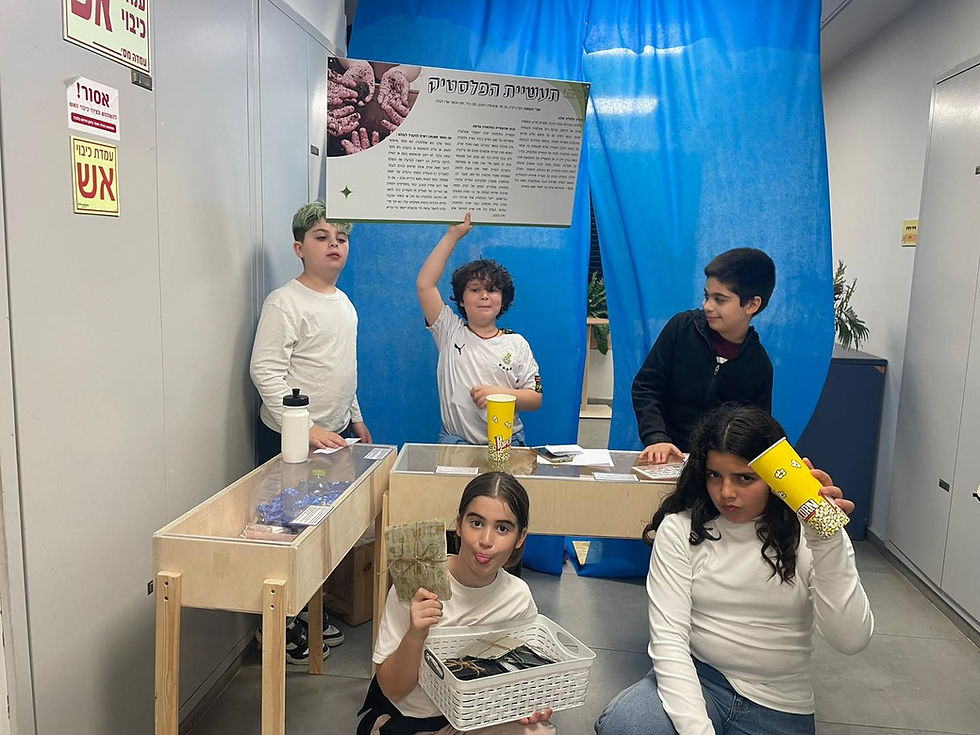
At the Dror Israel Elementary School in Rishon LeTzion, 4th and 5th grade students created exhibitions under the theme “The Future Museum,” focused on sustainability and the environmental impact of industries. One group examined the true cost of plastic-packaged food and presented practical alternatives such as reusable containers and locally made products. Another highlighted how much environmental damage remains invisible and offered hands-on solutions including sewing kits for repairing clothes, body scrub made from used coffee grounds, and reusable beeswax wraps to replace disposable plastic.
Dror Israel’s schools and social pedagogy have received Ministry of Education awards, and our learning pathways in Hebrew language, history, and social studies have been recognized as a model for the future of Israeli education, connecting academic excellence with civic responsibility and real-world engagement.
Across our network, learning is designed to move beyond memorization and testing. Students grapple with real questions, present their thinking publicly, and practice taking responsibility for the world around them. The project exhibitions offer a glimpse into that process: classrooms filled with conversation, students explaining their reasoning, visitors asking questions, and learning unfolding in dialogue.

This is education that strengthens both individual students and the society they are growing into, and we invite you to be part of it. Whether by visiting, partnering, or supporting this work, your involvement helps ensure that more students across Israel can experience learning that connects knowledge with responsibility, purpose, and action.


Comments